
Where licenses are scarce and home rule is not a realistic path, the alternative for prospective licensees is to buy an on-premises license from an existing license holder. While MGL c. 138, § 23, provides that “no holder of . . . a license . . . shall have any property right in . . . such license,” the reality in practice is that licenses are often transferred in a private secondary market.
Interviewees described the secondary market as an information-asymmetric environment in which those with the right connections hold structural advantages. There is no centralized database maintained by ABCC or another Commonwealth agency where listings of available licenses for sale and transfer are accessible to the public at large. Without a centralized database, prospective buyers must learn of opportunities through backroom channels, such as word of mouth, from attorneys known for brokering liquor licensing deals, or through other personal or business relationships.
The lack of public information about licenses that are available on the secondary market, and/or inactive licenses that should be available to prospective licensees, contributes to artificial scarcity, price inflation,166 and access barriers. A Cambridge restaurant owner identified access to capital as the central equity issue: In his experience, lenders’ risk criteria mean first- and second-generation minority operators often cannot borrow enough, at affordable terms, to compete for licenses.167 Resource asymmetry then compounds the information asymmetry.
Interviewees linked process costs—legal counsel, notice and publication expenses, and time spent navigating unfamiliar requirements—to unequal access to startup capital. A Boston hospitality consultant described a process that “cannot realistically be navigated without a lawyer,” with counsel commonly running $20,000–$50,000 before a six-figure license purchase is even on the table.168 A business owner in Malden put the point directly: The system “favors applicants with deep pockets and political connections and prevents small, first-time, less savvy” operators from competing.169 The practical result is that well-resourced and well-connected business owners are able to obtain licenses in a market that is inaccessible to those without significant financial resources or established industry relationships, especially first-time or independent business owners.
License scarcity converts a regulatory permission into a private asset class.
Once a license is found, the purchase price is a bargain between buyer and seller, and the deal itself is private. Scarce capacity of licenses leads to an unregulated private market where licenses are treated as commodities (the LLA and ABCC must still approve the transfer, but the review only asks whether the buyer and the premises are suitable). Interviewees described the commodification of licenses in striking terms. A Waltham municipal official observed that “licensees treat the license as their personal property: used for collateral for bank loans, transferred and sold by holder for any amount they want.”170 An official from Gloucester recounted a license that had been issued at $2,400 but was changing hands on the secondary market for several orders of magnitude more.171
To make matters worse, inactive or pocket licenses—issued licenses for underlying businesses that have closed or stopped operating—sometimes linger in private hands rather than returning to the municipal pool. A municipal employee from Southwick, a rural, western Massachusetts town, described a licensee whose restaurant had just closed: “He isn’t going to turn the license back in. He’s going to sell it with the business, because the business is worth more” with the license attached.172 MGL c. 138, § 77, permits, but does not require, LLAs to cancel licenses after a hearing if a licensee ceases to conduct the licensed business. In practice, this discretionary cancellation power goes largely unused: ABCC’s records contain issued, active licenses, but no field identifies whether the licensed business is still operating.173
A Boston hospitality consultant estimated that 10–15% of Boston’s total licenses may be inactive.174 He also called the market “commodities trading,” a concept previously seen with respect to licenses to operate taxis (medallions). Boston capped the number of taxi medallions for decades, and the resulting scarcity created a secondary market in which a medallion traded for as much as $700,000 by 2013. When ride-hailing companies entered the market without a comparable cap, that market collapsed: By 2023, a medallion was worth roughly $20,000. The episode illustrates that the price of a capped license reflects the regulatory limit rather than the value of the underlying business, and that the value substantially dissipates when the limit does.175
Another unintended consequence of licenses being treated as private assets is rental agreements for operating locations that include licenses. A Cambridge restaurant owner described the mechanism: Some landlords “effectively rent the license to the tenant by charging extra rent over the life of the lease while keeping the license attached to the building.”176
License scarcity drives transfer prices as high as $600,000 in areas of high demand.
Licenses in secondary market transactions are often valued significantly higher than the original acquisition cost. The scarcity created by state-imposed quotas fuels these inflated purchase prices. In survey responses, business owners reported what they actually paid to acquire a license on the transfer market in seven quota municipalities, with transfer costs reflecting the degree of local scarcity: $600,000, $450,000, $400,000, and $230,000 in Boston; $175,000 in Somerville; $100,000 in Beverly; $50,000 in Agawam; $25,000 in Easthampton; and between $1,600–$1,700 in Pittsfield and Abington. By comparison, business owners in two local-control municipalities—Cambridge ($2,500) and Haverhill ($2,600)—reported costs comparable to licensing fees in those municipalities, consistent with greater license availability under local control rather than quota scarcity.177 Where licenses remain available, transfers still occur (for example, when a buyer acquires an operating business and its existing license), but prices tend to approximate licensing fees rather than scarcity premiums.
Figure 23 on the next page shows reported one-time costs to acquire a license across 10 municipalities against the annual licensing fees for the same class of license.
Figure 23. Reported License Acquisition Costs178
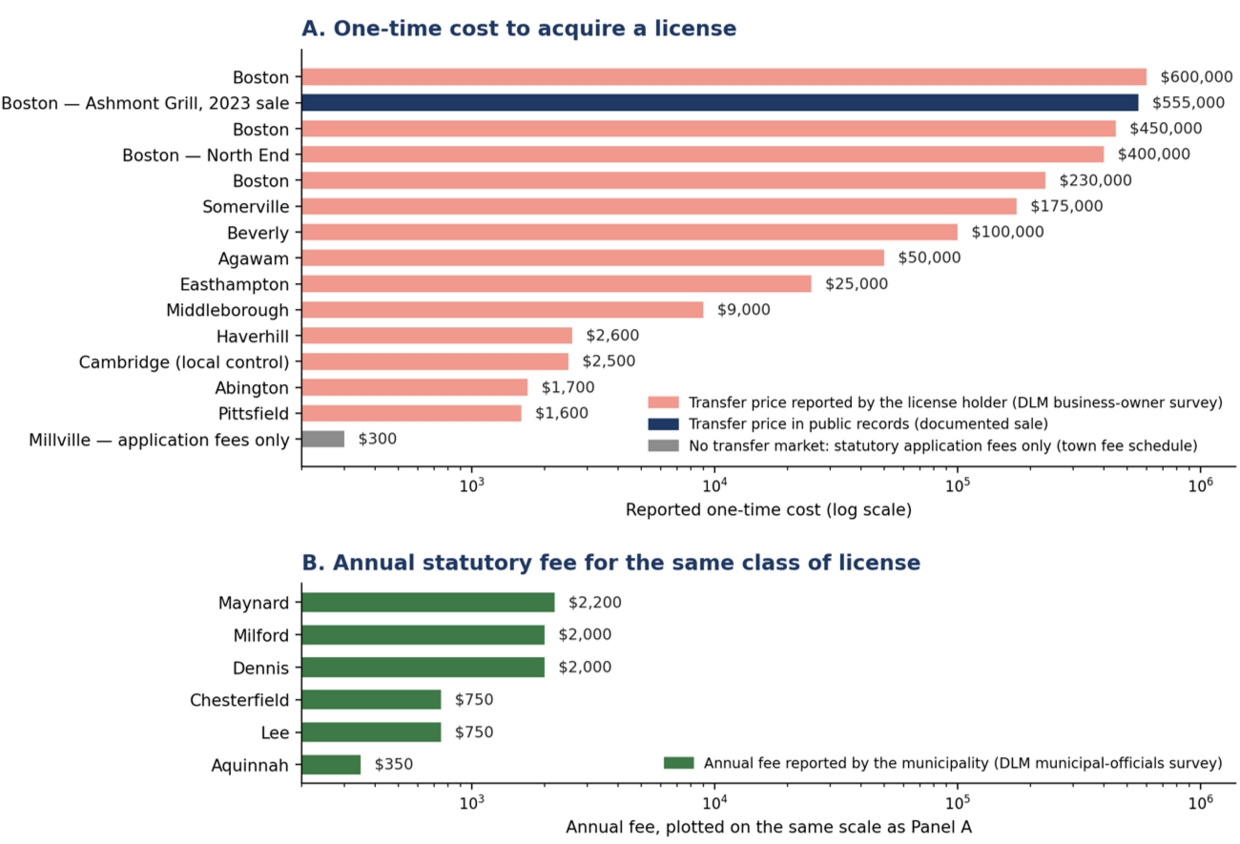
One business owner reported that they hold two all-alcohol on-premises licenses: one obtained through a new application in Boston at $3,017, and one acquired by transfer at $450,000.179 Another business owner reported acquiring a new on-premises license for $2,100 in Dorchester.180 In the same Boston neighborhood of Dorchester, the transfer of independently-owned Ashmont Grill’s all-alcohol license sold for 265x the price of a new license. Originally reported as part of a $650,000 total business and real estate acquisition in 2005, the license alone sold for $555,000 in 2023 to Back Bay’s Cactus Club Café, a multi-national restaurant chain with more than 30 locations.181 Rather than remaining in the Dorchester community to support local economic development, the license was sold on the secondary market and transferred to a high-volume chain in the Back Bay. That same year, Mayor Michelle Wu noted that “a full liquor license is going for $600,000-plus in the City of Boston.”182 The Boston Globe reported that All-Alcohol license sales in Boston in 2023 included a $600,000 license at the View Boston observatory lounge, $575,000 at One Congress, and $550,000 at Hood Park.183 However, although transfer prices may be reported to ABCC in license transfer applications, that information is not readily available to the public.
The two relief pathways produce identifiable winners and losers. Fewer public-sector checkpoints in the secondary market pathway may mean faster decisions, but it also means transactions are effectively dominated by whoever can afford to participate, with little accountability. The home rule pathway may result in lower license costs, but it is marked by unpredictability and delay and requires relationships with those in the know. The system favors those positioned to benefit from scarcity: established business owners in quota municipalities insulated from competition and whose license values appreciate on the secondary market, the brokers and attorneys who effect license transfers, and the officials and legislators who retain discretionary control over a valuable permission. The system hurts those least able to absorb delay and cost: prospective licensees who lack substantial capital or who lack the relationships or counsel needed to navigate either pathway, including small, family‑owned businesses; first-time business owners; immigrant entrepreneurs who may face language or information-access barriers; and municipalities for which revenue and growth are capped by an inability to meet license demand. Furthermore, since on-premises license access rises with municipal wealth (Finding 3), a relief system that sorts opportunity by capital and connections compounds the existing inequality rather than relieving it. These distributional effects motivate the recommendations in this report.
| Date published: | October 13, 2026 |
|---|