
This study recommends eliminating the state-imposed population-based quota for on-premises liquor licensing and establishing local control (Recommendation 1); improving information access, equity, and transparency in on-premises liquor licensing (Recommendation 4); and addressing the treatment of on-premises liquor licenses as transferable private assets (Recommendation 5). In the absence of legislative action on Recommendation 1, this study makes alternative proposals to increase equitable access to licenses (Recommendation 2) and to establish a criteria-based, non-legislative pathway to additional licenses (Recommendation 3).
Recommendation 1 addresses the supply and demand mismatch created by the state-imposed population-based quota formula (Finding 1) and the two-tier system resulting from a one-time exemption opportunity for certain municipalities (Finding 2). Recommendation 2 addresses unequal access to local-control authority (Finding 2). Recommendation 3 addresses the absence of a procedurally uniform pathway for quota municipalities to obtain additional licenses (Findings 1 and 4). Recommendation 4 addresses transparency and information access at the state and municipal levels (Finding 5). Recommendation 5 addresses secondary market transferability and scarcity-driven private pricing (Finding 4). Each recommendation is designed to address equity concerns in license access, including wealth and process disparities (Findings 3 and 4).
1. The Commonwealth should eliminate the state-imposed population-based quota for on-premises liquor licensing and establish local control.
This study recommends eliminating the state-imposed population-based quota for on-premises liquor licensing and establishing local control to remove structural constraints that create artificial scarcity,217 impose access barriers, and restrict economic growth. It is important to note that this recommendation is about establishing local control to make decisions that reflect local priorities. Local control does not, in and of itself, increase the number of licensed establishments: 5 of the 26 local-control municipalities actually issue fewer on-premises licenses than the quota formula would allocate to them.218 Every license in a local-control municipality remains subject to the same ABCC oversight, local public hearing requirements, suitability review, and enforcement rules.
As discussed in Finding 2, Massachusetts has already successfully tested eliminating the quota: Certain municipalities were able to exempt themselves from the formula, securing significant benefits without negatively impacting the Commonwealth. Those 26 local-control municipalities now collectively issue twice as many on-premises licenses per resident as quota municipalities—21.5 licenses per 10,000 residents for a local-control municipality compared to 10.9 for a quota municipality.219
It is difficult to justify continuing to operate under an archaic, inequitable two-tier licensing system.
Eliminating the quota will put all municipalities on equal footing, allowing them to choose how to activate neighborhoods, promote cultural vitality, and advance placemaking, while encouraging downtown revitalization and spurring economic growth by strengthening the restaurant and hospitality industries.
Local-control municipalities have collectively issued 30% more licenses than the quota formula would have allocated, while quota municipalities have had to navigate an opaque, unpredictable, insider-controlled home rule petition process to secure additional licenses.220 Four decades of local control demonstrate that municipalities are capable of exercising discretion and acting deliberately in liquor licensing.
As documented in Finding 1, the quota formula misallocates licenses against demand. Under the quota, 64 municipalities are constrained, having used 80% or more of their allocated licenses. These 64 constrained municipalities are home to approximately 2.5 million residents (41.6% of the quota population) but hold just 7.1% of the total remaining available quota licenses (263 of 3,729).221 Since 1978, when 26 municipalities gained local control, quota municipalities have turned to the Legislature repeatedly to close the gap between supply and demand: At least 227 special acts passed since that date have authorized licenses that remain active today across 101 municipalities.222 Each consumed municipal and legislative resources and delayed economic development.
Furthermore, Finding 3 demonstrates that wealthier municipalities have greater access to licenses. Not only does license issuance rise with municipal wealth across quota and local-control municipalities, but the inequity is compounded by the concentration of local control in higher-wealth quartiles. With respect to quota municipalities, wealth also correlates with successfully obtaining additional licenses under a home rule petition. Across the 328 quota and local-control municipalities, the highest-wealth quartile (Q4) issues 58% more licenses per resident than the lowest-wealth quartile (Q1). Moreover, the 73% of local-control municipalities that sit in Q3 and Q4 have EQV per capita between $237,537 and $2,817,820, while the remaining 27% fall between $83,573 and $221,787, and only three are Gateway Cities.223
A comparison of Somerville and New Bedford highlights the license access disparity between similarly situated municipalities. Both are constrained quota municipalities of comparable populations that have exhausted their formula allocations, and, under the formula alone, license access is nearly identical: 11.4 and 12.2 quota licenses per 10,000 residents. Somerville, a Q4 municipality, has obtained 52 licenses through special legislation; New Bedford, a Q1 Gateway City, has obtained only 9. Local control may resolve this differential.
Public safety arguments may be advanced in opposition to this recommendation.224 However, studies relied upon by public health stakeholders associating high alcohol-outlet density with higher rates of violent crime, impaired driving, and driving fatalities do not account for factors relevant to evaluating the effectiveness of the Commonwealth’s state-imposed population-based quota system.225 A 2006 publication synthesized outlet-density studies from jurisdictions including Los Angeles, Cleveland, New Orleans, and Newark.226 It did not, however, analyze the impact of liquor license quotas on public safety, compare public safety outcomes between quota and local-control municipalities, or establish whether elevated crime preceded outlet concentration.227 A statewide license count based on resident population neither measures nor limits the concentration of establishments within a municipality: Licenses in the Commonwealth’s densest markets cluster block by block under the quota today.228
The survey put the public safety question to the people closest to the system. Respondents raised valid counterarguments, including that filling vacant storefronts may, in fact, improve street-level safety. A restaurant owner in Orleans explained that “with proper enforcement, there is no issue,” because when a community has “plenty of other restaurants and liquor establishments,” it becomes “much easier to enforce rules on [a] particular establishment without public outcry or concern.”229 A business owner in Greenfield cautioned that “there is a greater danger to public safety from boarded up businesses,” which may attract crime.230
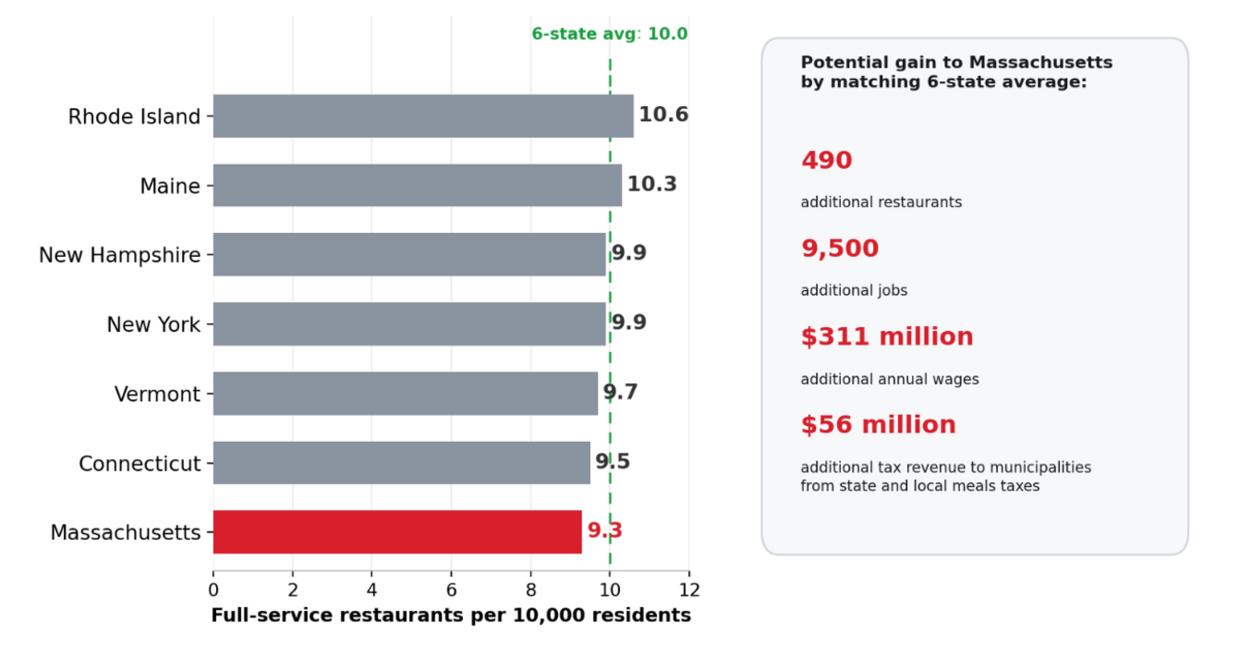
There is, however, persuasive evidence of the detrimental impact of the quota on local economic development. Reviewing data from other states in the northeast demonstrates the potential statewide negative implications of the quota formula. In 2022, Massachusetts was home to approximately 6,476 full-service restaurants (9.3 full-service restaurants per 10,000 residents).231 In comparison, Rhode Island supported 10.6 full-service restaurants per 10,000 residents, Maine 10.3, New Hampshire and New York 9.9, Vermont 9.7, and Connecticut 9.5, for an average of 10 restaurants per 10,000 residents.232 While these differences appear small, an increase in Massachusetts restaurants to this average would mean 490 additional restaurants.233 In 2022, full-service restaurants in the Commonwealth employed an average of 19.4 people at $32,661 compensation and grossed $1.65 million.234 Extrapolating these numbers to the additional 490 restaurants illustrates the economic opportunity cost borne by the residents of Massachusetts as a result of the quota system: roughly 9,500 jobs and $311 million in annual wages. The economic opportunity cost borne by Massachusetts municipalities as a result of the quota system is estimated at $50 million a year in state meals tax and $6 million in local‑option meals excise tax generated by $809 million in meals sales.235
Figure 33 below illustrates the potential lost economic opportunity to Massachusetts resulting from the liquor license quota.
Figure 33. Potential Lost Economic Opportunity Resulting from Quota
Previously proposed and pending legislation would implement this recommendation. Section 10 of H.437 and Section 228 of S.3228 provide that “a city or town shall determine the number” of on-premises licenses to be issued by its local licensing authority (LLA), and strike contradictory provisions in MGL c. 138, § 17.236 Findings 1, 2, and 3 of this report—the supply-demand mismatch created by the 1933 population formula, the inequitable two-tier system, and the correlation between municipal wealth and license access—provide the evidentiary basis that supports implementation.
In summary, establishing local control would eliminate the inequitable two-tier system and the structural constraints that create artificial scarcity,237 placing all municipalities on equal footing. Local control empowers municipalities to grow vibrant economies and reduces wealth and other access barriers for prospective licensees that have been created by the state-imposed population-based quota, making room for small, independent, or first-time business owners. As expressed by a Southwick official, “Our municipality knows the needs of the community and should be the determining factor on how many licenses we believe are sufficient to serve our community.”238
2. Increase equitable access to licenses by opening recurring windows of opportunity for municipalities to opt out of the state-imposed quota formula.
Finding 2 shows that the 1978–1984 exemption window created a two-tier system in which 26 municipalities have local control over on-premises licensing and 302 municipalities are subject to the quota formula, without taking into account any relevant factors impacting license demand. In the absence of eliminating the state-imposed population-based quota formula, the Legislature should consider immediately opening a window of opportunity for municipalities to obtain local control over on-premises liquor licensing and consider recurring windows to give municipalities flexibility to respond to changing conditions over time, increasing equitable access to licenses.
The process for obtaining local control should be transparent with objective, uniform criteria across municipalities. The Legislature should consider specifying:
- Eligibility: All non–local control municipalities should be eligible.
- Timing: The initial window should open no later than December 31, 2027, to provide immediate, long-overdue relief. Additional windows should open on a recurring schedule, such as once every 5 years, or every 10 years following the decennial census.
- Duration: Each window should remain open for a period of time that is sufficient to allow all municipalities to receive notice of the opportunity, evaluate local conditions, educate and engage with residents and stakeholders with time for meaningful public input and debate, and participate in accordance with their regular local governance schedules.
- Approval mechanism: The local approval process should be determined and specified, e.g., by ballot, town meeting, city council, or other local governance process.
With objective, uniform criteria, municipalities may be better able to evaluate whether the quota formula sufficiently meets their needs based on local factors, which may include tourism, seasonal populations, commercial density, restaurant and hospitality demand, redevelopment, economic-development goals, unmet applicant demand, enforcement capacity, administrative capacity, and community input. Before acting, a municipality may hold public hearings and share relevant information—current quota allocation, licenses issued and available, license utilization, inactive licenses, and application volume—so that residents, business owners, and officials can judge whether the formula aligns with local priorities.
Local control provides municipalities with the flexibility to evaluate license supply locally; it is not a mandate for municipalities to issue more licenses. Under this recommendation, a municipality that accepts local-control authority would still issue licenses through the same local and ABCC processes and licenses would remain subject to enforcement, suspension, and revocation. To preserve accountability, municipalities that accept local-control authority should report license issuance, availability, license utilization, known inactive licenses, and enforcement actions through the statewide platform described in Recommendation 4, on the same cadence required of all municipalities.
The issue is not that every quota municipality needs more licenses or that every municipality will want local-control authority. The issue is that access to local-control authority currently depends on whether a municipality was eligible for and used a temporary statutory process more than four decades ago. This recommendation addresses that equity concern.
3. Establish a criteria-based, non-legislative pathway to obtain additional licenses in conjunction with ABCC.
In the absence of eliminating the state-imposed population-based quota formula, the Legislature should consider establishing a streamlined, procedurally uniform, and objective criteria-based pathway for quota municipalities to obtain additional on-premises licenses without needing to resort to a home rule petition. As discussed in Finding 4, the home rule petition process is opaque and slow, with uncertain outcomes that depend on relationships and municipal capacity. The Legislature should consider acting quickly to make this policy change effective no later than December 31, 2027, and empower and fund ABCC to administer this pathway promptly.
To ensure equity and transparency in this process, objective eligibility criteria for obtaining additional licenses under this pathway should be specified and consistently applied. Criteria may include the following:239
- whether the municipality is at the quota limit;
- whether the municipality is constrained or has license utilization exceeding a particular percentage;
- whether the municipality has enforcement capacity substantiated by public safety officials;
- whether the municipality has consistent, demonstrated seasonal population fluctuations;
- whether a municipality has environmental justice240 blocks that are not currently served by an on-premises licensed establishment;
- how closely the demographics of existing license holders in a municipality track the municipality’s population demographics as reported in the most recent census data, to reflect systemic obstacles faced by minority business owners and to promote the municipality’s character and cultural identity;
- the percentage of licenses held by other business owners frequently facing systemic obstacles to achieving viable economic status, including women, veterans, service-disabled veterans, people with disabilities, and people in the LGBTQ+ community; and
- the extent to which additional licenses would support first-time and minority license holders, locally owned establishments, and small-scale operators, consistent with the municipality’s economic development plan.
In designing eligibility criteria, the Legislature should consider how to address the wealth and information barriers documented in this report.
This study recommends that a uniform and transparent municipal process be publicly available. It would be helpful for prospective licensees to have access to a process, such as the following, in which:
- requests may be raised to the municipality’s LLA by any interested party;
- the LLA maintains records of all requests and brings requests to the municipality’s governing body;
- the municipality places all requests on a meeting agenda to occur no later than the next regularly scheduled public meeting and gives sufficient public notice;
- the municipality gathers all available evidence as to whether the eligibility criteria are met, to be shared with the public no later than a specified number of days (e.g., seven business days) before the public meeting;
- the municipality provides opportunity for public comment and votes no later than the next regularly scheduled public meeting, in accordance with local law (by ballot, town meeting, city council, or other local governance process); and
- if voted upon favorably, the municipality submits an application to ABCC within a specified timeline (e.g., 30 days) of the vote.
The pathway should also require a uniform and transparent review process by ABCC. The nature of ABCC’s review should be ministerial: A determination whether the eligibility criteria are met should be issued in writing within a specified timeline (e.g., 30 days) and made public, through an application portal that is simple, accessible, multilingual, and mobile-friendly, with document upload and status tracking.
Application records, determinations, and comprehensive municipality-level licensing data (allocation, license issuance, license utilization, home rule petitions, inactive licenses, etc.) should be collected and published through the statewide data platform described in Recommendation 4. The statewide data platform should be searchable and exportable for independent review by the public.
Licenses allocated to the municipality under the new pathway would continue to be issued to licensees in accordance with the ordinary licensing process. Individual applications would remain subject to LLA review, public hearing requirements, public notice where applicable, applicant suitability review, premises review, license conditions, ABCC approval, enforcement, suspension, and revocation.
In summary, this recommendation addresses the quota’s misalignment of supply with demand and the obstacles of the currently available relief pathways. The proposed new pathway addresses access and equity concerns by reducing reliance on home rule petitions and establishing an expedited, predictable, transparent process.
4. Improve information access, equity, and transparency in on-premises liquor licensing.
Finding 5 documents that prospective licensees and the public lack consistent, complete procedural information about license availability and the application process. Whatever the Legislature decides about the state-imposed population-based quota, this information gap will persist unless it is addressed directly. Applicants today cannot readily identify how many available licenses their municipality has, how many are active, how many have been transferred, or whether licenses are subject to restriction.
Even state and municipal officials are sometimes confused as to whether a municipality is a quota or a local-control municipality. Two examples expose the magnitude of this institutional knowledge problem. Dartmouth, which exempted itself from the state-imposed population-based quota, was mischaracterized as a quota municipality in ABCC’s records until 2016, when the town assembled its own evidence to prove that it qualified as a local-control municipality.241 In 2018, a lawsuit filed by former owners of defunct businesses against the City of Cambridge exposed a similar issue. The suit claimed that municipal officials had misinformed certain prospective business owners that licenses were only available via purchase and transfer from an existing license holder when Cambridge had exempted itself from the quota decades earlier.242
This recommendation offers three measures to reform and resolve the disconnect in information between the Legislature, ABCC, municipalities, and prospective licensees: a statewide data platform (4.1), municipal process standards (4.2), and transparency in the home rule pathway (4.3).
4.1 A statewide licensing data platform
The Commonwealth should enable and require ABCC to have a centralized, modern data collection platform to collect data consistently from all municipalities and make this data available to the public by producing relevant reports and providing access to searchable, interactive data within the next fiscal year.
Rather than placing the burden on 351 municipalities to determine what to collect and how, the Commonwealth should provide a single, shared platform for municipalities at no cost, in which each field has a required format, municipal dashboards update automatically, and the state view aggregates automatically. Standardizing the data upstream, where it originates, avoids the manual reconciliation this study required and keeps the municipal and state views consistent.
The state should create a unified, master liquor licensing platform to ensure that licensing data is consistently and transparently provided at both the state and municipal levels. The platform should collect the following data to ensure standardization and deliver it to municipal websites in an automated fashion:
- quota, local control, or other status;
- liquor licensing local options that have been accepted by the municipality, including § 12D conversions;
- the total number of on-premises licenses allocated under the statutory formula, if applicable;
- the number of licenses currently available;
- the number of licenses currently issued, by type and status (whether pursuant to quota, special legislation, or § 12D conversion; whether active, inactive, suspended, revoked, or location-restricted; and whether transferable, with history and dates);
- the identity, contact information, licensed establishment address, and license type of every active licensee;
- enforcement actions;
- licensing fees and transfer prices where available;
- a real-time waiting list for prospective applicants in constrained municipalities;
- a registry of licenses available for transfer, including inactive licenses, with reporting required by the existing holders for posting in the public platform for a specified window of time before a license may be transferred;
- a registry of pending home rule petitions, including filing date, status, sponsor, and associated documents; and
- all other relevant information collected by or available to ABCC.
The state platform should provide a dashboard to municipalities to automatically capture raw license data as it is created locally. Municipalities would use this dashboard to review applications, issue approvals, and manage licensing fees. The system should automatically take the data from the diverse municipal workflows and standardize it behind the scenes into one uniform digital format. Once an action is taken on a license in the municipal dashboard, the system should automatically update public-facing views at both the state and local levels in real time. The platform should be searchable, exportable, and machine-readable and should be equipped with a publicly accessible API to facilitate independent review and analysis.
4.2 Municipal process standards
Finding 5 documents that applicants who succeed locally often do so because individual municipal staff members walk them through processes that are not detailed and published in writing. The result is a system in which similar applications may receive disparate treatment, depending on who is at the counter and whether the applicant happens to connect with the right person. This study recommends that municipalities increase transparency and equity by establishing and communicating clear processes.
This study recommends that every municipality publish, by the end of the current fiscal year, a clear and uniformly applied licensing process. Municipalities are encouraged to include the following on their websites, in plain language (and, where the local population warrants, in additional languages):
- the full process for obtaining an available on-premises license (including forms, fees, notice requirements, hearing procedures, timelines, etc.);
- objective criteria that the LLA will apply when evaluating an application;
- a waiting list and procedure for when no licenses are available, and an indicator of where a prospective licensee falls on the list;
- the process for initiating a request for additional licenses under any available pathway; and
- contact information for the staff members and elected officials responsible for licensing decisions.
This recommendation eliminates the information access barrier that most significantly impacts those without capital or connections, including first-time applicants, immigrant operators, and small-business owners without counsel.
4.3 Transparency in the Home Rule Petition Process
For as long as home rule remains a license relief pathway, it should operate as a public proceeding rather than a closed-door negotiation. This study recommends the immediate implementation of the following transparency improvements that do not impede legislative authority:
- published, written criteria for evaluating home rule petitions for additional liquor licenses;
- a published, defined process with key steps and timelines;
- a centralized status tracker for every liquor licensing petition (filed, scheduled, heard, voted, signed, or denied, with dates); and
- written rationales for all home rule decisions.
Processes for granting valuable government privileges should operate based on defined, objective criteria and rules, and all steps and decisions should be available to the public. Special legislation liquor licenses under home rule petition should not be awarded behind closed doors, on the basis of unwritten convention or personal relationships.
The reforms included in this recommendation are necessary irrespective of any changes the Legislature may or may not make with respect to on-premises liquor licensing, to eliminate information gaps and asymmetries that benefit some while disadvantaging others. An equitable liquor licensing system cannot exist without increasing information transparency and accessibility.
5. Address the equity and wealth-access barriers created by the secondary market for on-premises liquor licenses.
Finding 4 documents a secondary market in which a regulatory privilege functions as a private asset. While MGL c. 138, § 23, provides that “no holder of . . . a license . . . shall have any property right in . . . such license,” as illustrated in this report, the reality in practice is that licenses are often transferred in a private secondary market. Artificial scarcity243 created by the quota system drives the transfer of licenses at exorbitant prices, creating wealth-access barriers.244 This study recommends that the Legislature, therefore, address the equity issues resulting from the transferability of licenses.
Pending bill S.3228 includes previous proposals to establish local control and address license transferability, providing that “all new licenses issued under this section in response to an application filed on or after January 1, 2027 . . . shall be nontransferable” and “if a license issued pursuant to this section is cancelled, revoked or no longer in use by the license holder” or “if a license holder closes or terminates the license holder’s business or sells or transfers the license holder’s business,” the license shall be returned to the licensing authority.245
The evidence in this study supports the enactment of nontransferability provisions. The Legislature should assess the impact of legislative changes, if any, to the liquor licensing system to ensure that identified equity and wealth-access barriers are addressed.
| Date published: | October 13, 2026 |
|---|