
Liquor licenses are central to economic development in nearly every Massachusetts municipality, contributing to downtown redevelopment and the success of the Commonwealth’s restaurant, tourism, and hospitality industries. Licenses are allocated to most municipalities through a state-imposed population-based quota formula (a statutory cap on the number of licenses each municipality may issue, scaled to its resident population).3 Municipal local licensing authorities (LLAs) review applications and issue licenses while the Alcoholic Beverages Control Commission (ABCC) oversees the liquor licensing system at the state level.
The Commonwealth’s liquor licensing system has been a recurring subject of reform and discussion, particularly during the past decade with respect to who should control the number of licenses a municipality may issue and their transferability. In 2014, then Governor Patrick proposed an economic development bill that included provisions to “[place] authority for granting liquor licenses in the hands of municipalities to allow local communities to make responsible decisions regarding their economic development and growth.”4 These provisions were excluded from the House redraft of the bill.5
In 2015, then Governor Baker proposed legislation that included similar provisions, as well as addressing license transferability.6 These provisions were again excluded from House redrafts.7 Similar legislation has been refiled in each legislative session since, with H.437 filed by State Representative McKenna in 2025 sent to study, and provisions included in the proposed Senate’s fiscal year 2026 budget stripped during conference committee negotiations.8 The final conference committee report on the fiscal year 2026 budget instead included MGL c. 138, § 12D, which is a limited provision permitting existing wine-and-malt licensees to convert their licenses to nontransferable all-alcohol licenses; it did not, however, give municipalities the ability to increase the number of their issuable licenses.9 In July 2026, the Senate returned to the question of municipal liquor control in an economic development bill.10 The provisions in that legislation, S.3228, effectively mirror Governor Baker’s proposals, rewriting MGL c. 138, § 17, to provide that “a city or town shall determine the number” of on-premises licenses it issues and to address license transferability.11
In 2017, State Treasurer Goldberg, whose office houses ABCC, convened a task force to review the liquor licensing system and issue recommendations.12 The resulting report recognized that “the licensing process in Massachusetts needs updating” and that “today’s capital markets are more complex than in 1933 when Mass. Gen. Laws ch. 138 emerged.”13 This study adds to that work, evaluating specific concerns raised by stakeholders, including artificial scarcity,14 exorbitant private market costs, neighborhood inequity, information gaps, and opaque home rule processes.
These concerns remain unresolved. This study examines equity, access, and other impacts of the liquor licensing system on municipalities and prospective licensees, specifically: (1) how the quota formula functions, (2) whether access to liquor licenses is equitable, (3) who bears the cost of artificial license scarcity, and (4) the barriers to access created by existing statutory and administrative processes. The analysis focuses on on-premises licenses—licenses issued to restaurants, bars, hotels, and similar establishments to serve alcohol for onsite consumption.15 It does not include off-premises licenses, which are subject to their own quota, or other license categories.16
This study draws on five complementary lines of evidence: fiscal year 2024 (unless otherwise noted) licensing data provided by ABCC (see Appendix B); socioeconomic data (see Appendix B); a review of governing laws and proposed legislation (see Appendix E); a survey of business owners, municipal officials, and state officials (see Appendix C); and in-depth interviews with license holders, industry consultants, municipal officials, and state officials (see Appendix C). The technical details behind each—data sources, definitions, statistical methods, and survey and interview administration—appear in Appendices B, C, and D.17
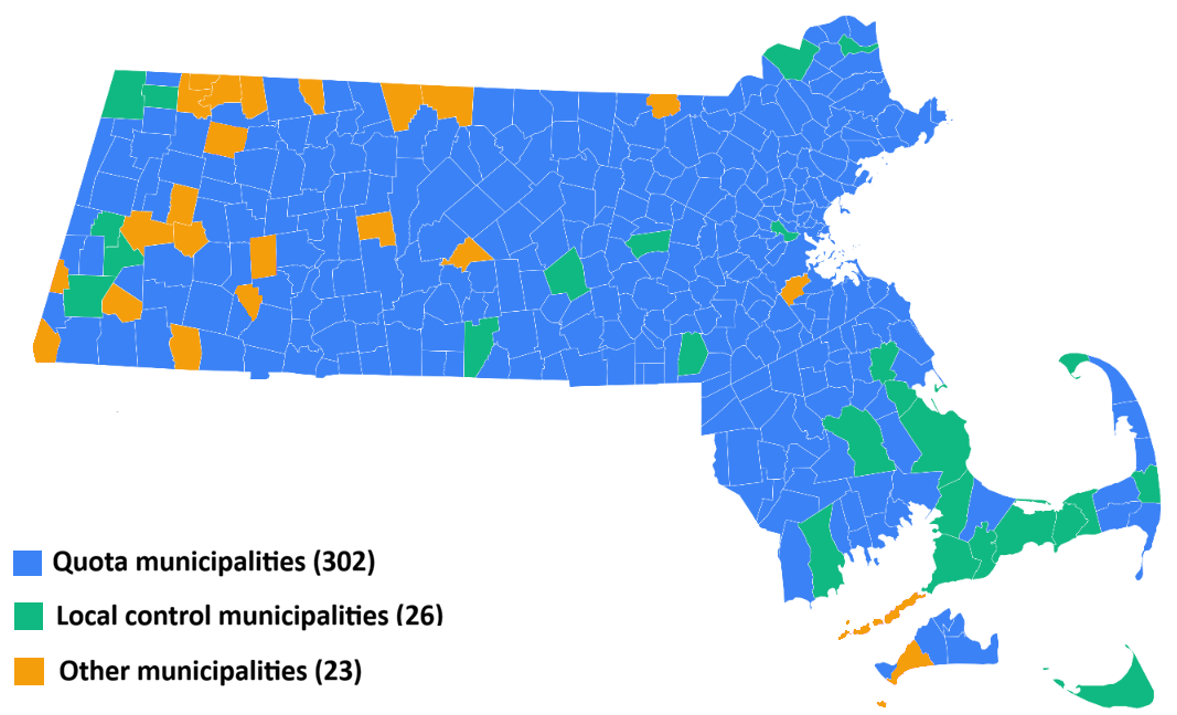
This study classifies the Commonwealth’s 351 municipalities into three groups, as shown in Table 1 below: 302 quota municipalities for which on-premises license counts are capped by the state-imposed population-based formula, 26 municipalities that are exempt from the quota formula (local-control municipalities), and 23 municipalities in categories outside the scope of this study.
Table 1. Classification of Municipalities
| Classification | Count | Definition | Population18 |
|---|---|---|---|
| Quota Municipalities19 | 302 | Subject to state-imposed population-based quota limits on MGL c. 138, § 12, on-premises licenses | 6,081,934 |
| Local-Control Municipalities20 | 26 | Exempt from state-imposed population-based quota limits on MGL c. 138, § 12, on-premises licenses | 872,735 |
| Other21 | 23 | Excluded from the scope of this study | 46,730 |
On the next page, Figure 1 provides an alternative view showing the numerical distribution of municipalities among these three classifications, and Figure 2 shows the geographic distribution of these municipalities.
Figure 1. Distribution of Massachusetts Municipalities by Licensing Classification
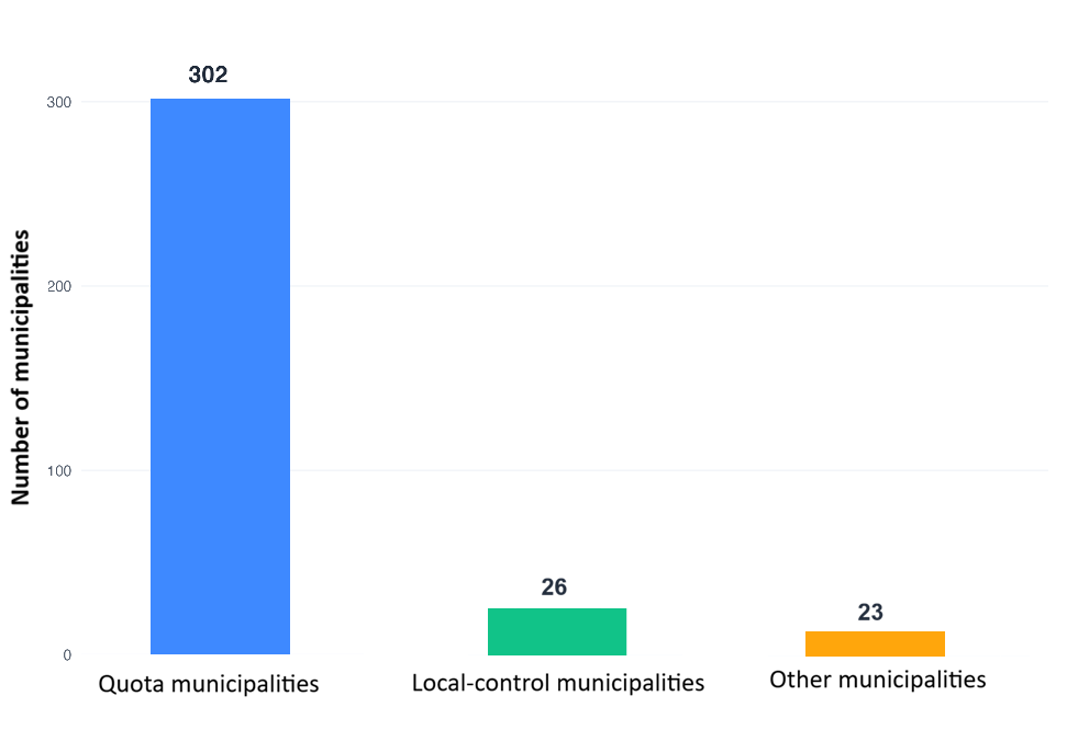
Figure 2. Map of Massachusetts Municipalities by Licensing Classification
This study evaluated the practical impact of the population-based quota system on municipalities using two measures: license utilization and license access. License utilization calculates the percentage of a municipality’s licenses allocated under the quota formula actually issued to license holders. License access calculates the number of all on-premises licenses (including licenses allocated outside the quota formula) issued within a municipality, per 10,000 residents.
This study’s findings are grounded in a comprehensive review of quantitative and qualitative evidence. The findings support the study’s actionable recommendations to make the liquor licensing framework more equitable, accessible, and transparent, while respecting each municipality’s unique needs and priorities.
| Date published: | October 13, 2026 |
|---|