
Interviewees report issues at the state level with the information environments presented by both ABCC and the Legislature, again exacerbating the relationship dependency of a process that already contains significant barriers to equity.
The ABCC portal lacks sufficient information for prospective licensees, municipalities, and the public.
Interviewees’ accounts of ABCC were mixed and varied by municipality and staff member contact. Some stakeholders described inconsistencies and delays, while others described ABCC as responsive and useful when local paperwork was complete. The variation suggests that applicants and municipalities may receive different levels of guidance depending on their ABCC contact, the type of license involved, and how much institutional knowledge is available at the time. A Lenox town official explained: “ABCC can be very inconsistent. They were dialed in for a period of time where you knew a name and knew they would be a good resource for you. We often said when an alcohol licensing issue came up, ‘Oh, let’s call so-and-so at ABCC.’ They would generally get back to you within a day or two, and you’d get a firm answer or helpful guidance. Then people leave, and that person doesn’t work there anymore and the new person may not be as helpful or knowledgeable as the previous person.”201 When processes are not adequately documented, prospective licensees must rely on knowledge transferred through relationships. Where institutional knowledge is not equally held by all agency staff members, this information asymmetry further perpetuates system inequities.
The reliance on individual ABCC guidance matters because ABCC’s website does not provide complete data relevant to prospective licensees and municipalities. Although the website provides certain information, including application forms, frequently asked questions, commission advisories and decisions, and active-license lists, it omits critical information and live, aggregate data across municipalities. The website also does not provide an interactive map of licenses by location, type, or holder. As of July 2026, prospective applicants and municipal officials cannot readily determine, for a specific municipality, whether it is subject to the quota or holds local-control authority; how many licenses the formula allocates and how many additional licenses special legislation has authorized; how many licenses are issued by type and how many remain available; each license’s status (active, inactive/pocket, suspended, or revoked) and applicable dates; whether inactive/pocket licenses exist; whether licenses may be available for transfer; what acquisition costs would be, licensing fees, and, where licenses change hands privately, transfer prices; whether a municipality has pending special legislation for additional licenses; and who holds each license and at what address. None of this information is consolidated in one dashboard, and some of it is not publicly available at all.
A review was conducted of three public portals—the Massachusetts ABCC portal, the Maine Bureau of Alcoholic Beverages and Lottery Operations’ portal, and the New York State Liquor Authority’s Open Data portal—on record search and filter capabilities, exportability of results, availability and status of licenses, and whether records were presented in a location map or interactive platform.202 Each state operates a different licensing framework, so no portal transfers wholesale.
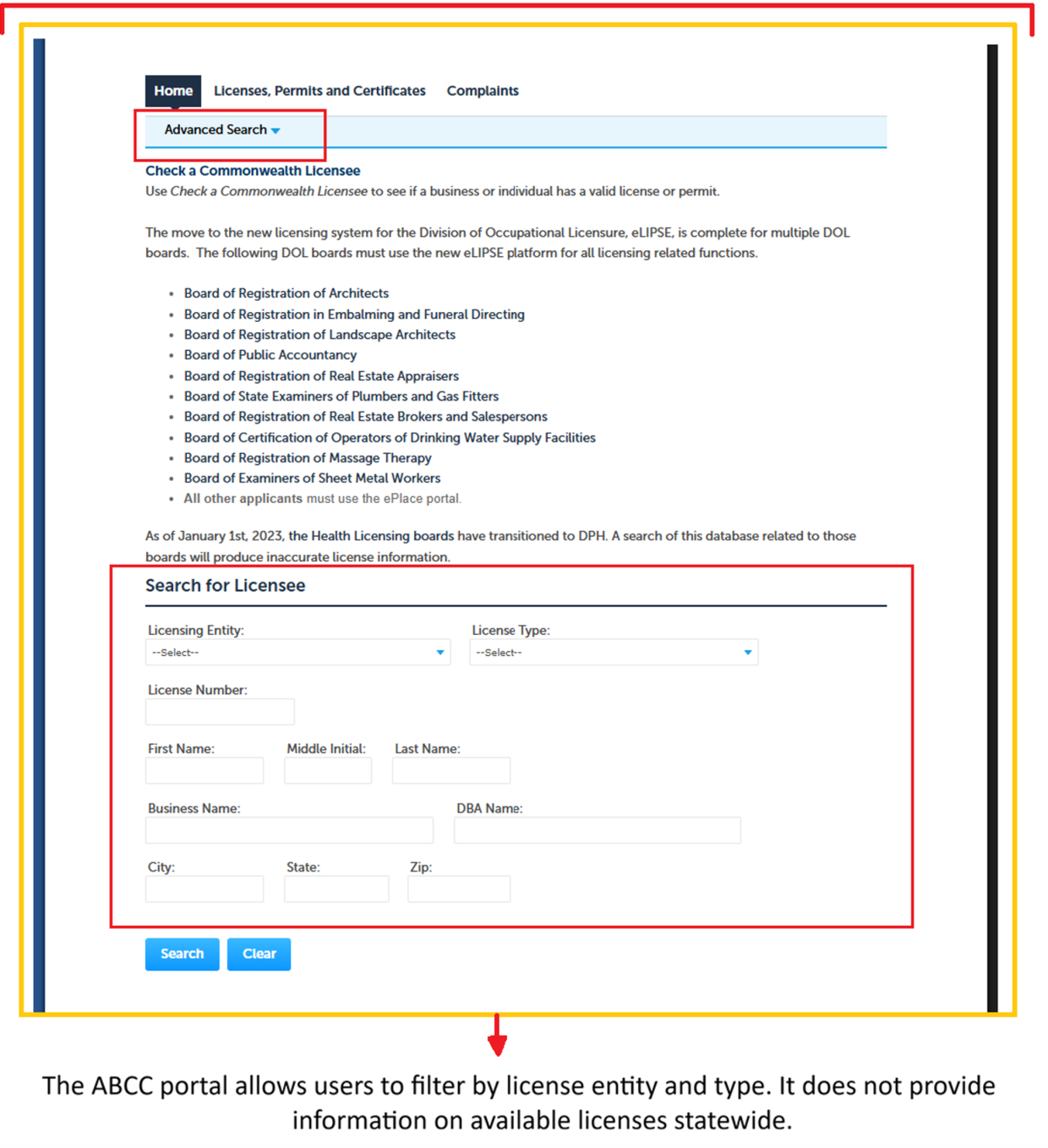
The Massachusetts ABCC portal’s licensee search feature allows users to filter by state agency, e.g., ABCC, and license category, e.g., on-premises licenses (see Figure 29 on the next page). Users are then able to download the resulting list as a CSV file. The portal does not, however, publish live, cumulative, aggregate information on available licenses by municipality and statewide, including licenses available for transfer. Logging in to the portal does not expand the public information available. Municipal users described the portal as difficult to navigate. A Hinsdale municipal employee reported that the site “isn’t user-friendly for people who aren’t computer-savvy.”203 Officials more often identified what the portal does not show. A Lee municipal employee asked for additional information regarding application status: Instead of a record simply reading “closed,” it would help to see “Application w/ Investigator” or “Application Moved Ahead to Commission.”204
Figure 29. The Massachusetts ABCC Portal205
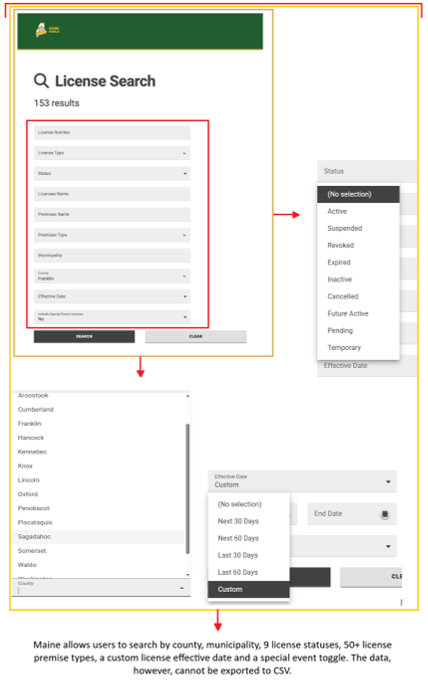
The Maine Bureau of Alcoholic Beverages and Lottery Operations’ portal provides additional search filters, including county and municipality, nine license statuses, 50+ license premise types, custom effective dates (including future active dates), and a special-licenses toggle—beyond those of the Massachusetts ABCC portal (See Figure 30 on the next page).206 Although Maine provides a similar platform to ABCC, with some expanded filters, it is important to note that Maine does not allocate licenses by population, and licenses are nontransferable.207 The Maine Bureau of Alcoholic Beverages and Lottery Operations’ portal and the level of information provided, therefore, may be appropriate for the Maine liquor licensing system but insufficient for the Massachusetts liquor licensing system, which is significantly more complex.
Figure 30 The Maine Bureau of Alcoholic Beverages and Lottery Operations’ Portal208
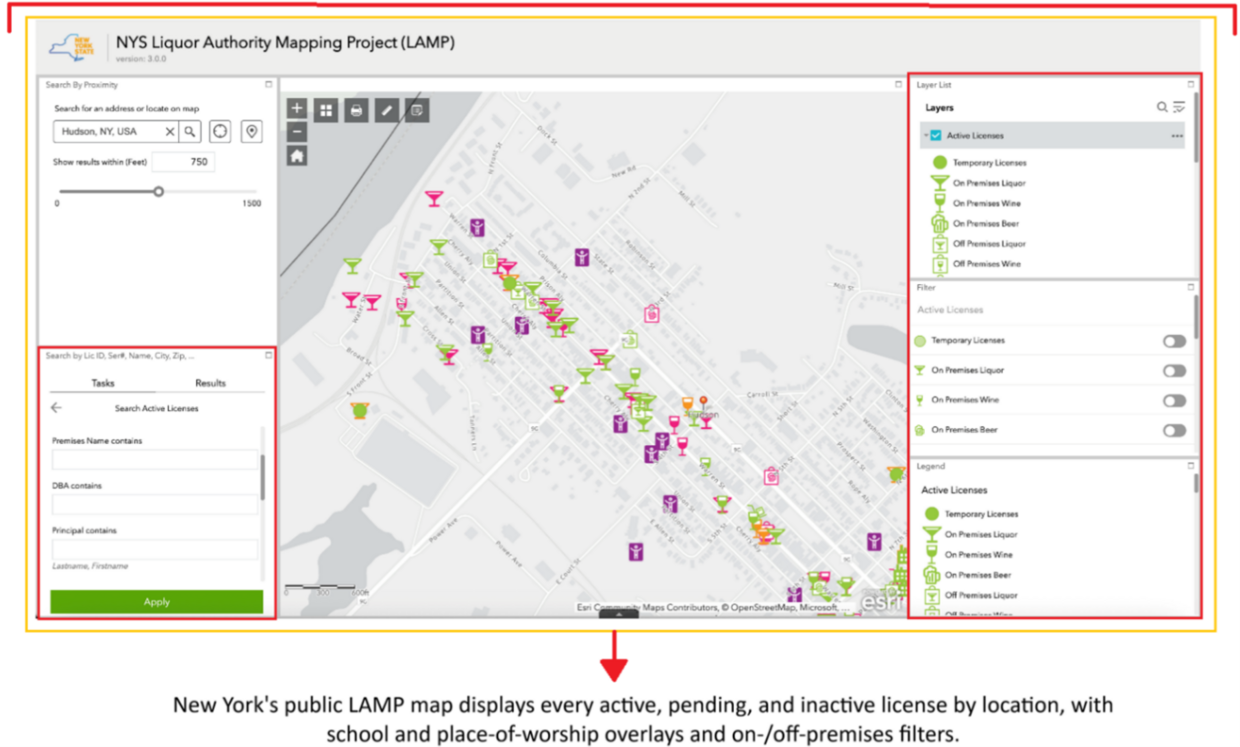
The New York State Liquor Authority’s Open Data portal hosts a dataset, updated daily, of every active license, including license class, expiration date, and precise coordinates, and exposes it through a public-facing application programming interface (API).209 The New York State Liquor Authority’s Open Data portal underlies the Liquor Authority Mapping Project, a public map of every active and pending license in the state, showing the locations relative to schools and places of worship.210 Figure 31 and Figure 32 on the next pages show screenshots of the New York State Liquor Authority’s Open Data portal and mapping tool, which place applicants, local officials, regulators, and the public on an equal informational footing.
Figure 31. New York Liquor Authority Open Data Portal211
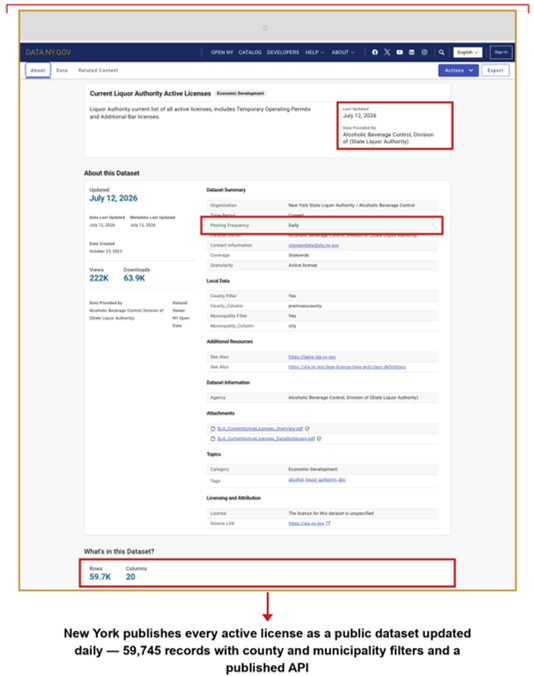
Figure 32. The New York Liquor Authority Mapping Project212
These examples show that licensing information and data can be available in real time and be more robust, searchable, transparent, customized, and user-friendly. Specifically, licensing data can be organized not only as individual records but also as a public information system that helps applicants, municipalities, regulators, and the public more easily understand license statuses, locations, and availability.
A review of ABCC’s portal identifies deficiencies, including insufficient information about license cost, availability, transferability, and status. Moreover, Massachusetts has no public API, preventing data from being queried or integrated programmatically at scale. These limitations make the system opaque and reinforce barriers to access for prospective licensees, researchers, and the public. The current manual, record-by-record lookup process is outdated and inefficient and obstructs oversight.
The Massachusetts legislative website lacks sufficient information for prospective licensees, municipalities, and the public.
Interviewees and survey respondents noted a lack of clear, consistent, and complete procedural information and data in connection with home rule petitions and liquor licenses under resulting special legislation. A municipal employee from Northampton described the consequence for a municipality that has used the pathway repeatedly: “The process is opaque and undefined.”213 A Maynard employee who observed the yearlong trajectory of a home rule petition beginning in late 2024 reported that “it was difficult to understand which offices were involved and at which stage.”214
A review of the Massachusetts legislative website found no guidance as to the process and no criteria employed by the Legislature for determining the fate of these home rule petitions. Moreover, information regarding the status of past and pending home rule petitions is fragmented across years of legislative records rather than being provided to ABCC for incorporation into a comprehensive, centralized data repository.215 An ABCC employee confirmed this information gap in a July 2023 interview, explaining that ABCC does not maintain systemized data on licenses authorized by special legislation—such licenses are associated with individual application files—or home rule petitions that were filed but did not pass.216
Together, the municipal and state information environments burden prospective licensees who lack capital and connections. Clear and consistent procedural guidelines, articulated criteria, and complete, searchable live data are necessary for removing access barriers and making the liquor licensing system more equitable.
| Date published: | October 13, 2026 |
|---|