
Massachusetts State Seal An official website of the Commonwealth of Massachusetts Here's how you know

Official websites use .mass.gov

A .mass.gov website belongs to an official government organization in Massachusetts.

Secure websites use HTTPS

A lock icon or https:// means you've safely connected to the official website. Share sensitive information only on official, secure websites.

Finding 5.1 - License to Pour: Access & Equity in Massachusetts Liquor Licensing Report

A lack of uniform data collection, reporting, and website content standards prevents statewide market analysis and fosters relationship dependency in liquor licensing.

Before an applicant can apply for an on-premises license, the applicant must first understand the licensing process. Applicants report a need for clarity in local procedures, hearing requirements, and notice rules; access to more data, including license availability and cost; identified contacts for assistance during the process; and language support.184

Since the state does not specify what information and data should be provided, municipalities maintain their own website content, and what an applicant finds online varies in format and depth from one municipality to the next. A sample of municipal websites was reviewed to see what that variation looks like in practice, including the websites of the Commonwealth’s three most populous municipalities, Boston (quota municipality), Springfield (quota municipality), and Worcester (local-control municipality), as well as the websites of Southwick and Palmer—two quota municipalities with under 20,000 residents and no quota All-Alcohol licenses remaining.185

Boston’s website includes a step-by-step application guide, hearing schedules, advisories, licensing materials in seven languages, and a downloadable dataset of active licenses with locations.186 See Figure 24 on the next page.

Figure 24. City of Boston Licensing Board Website187
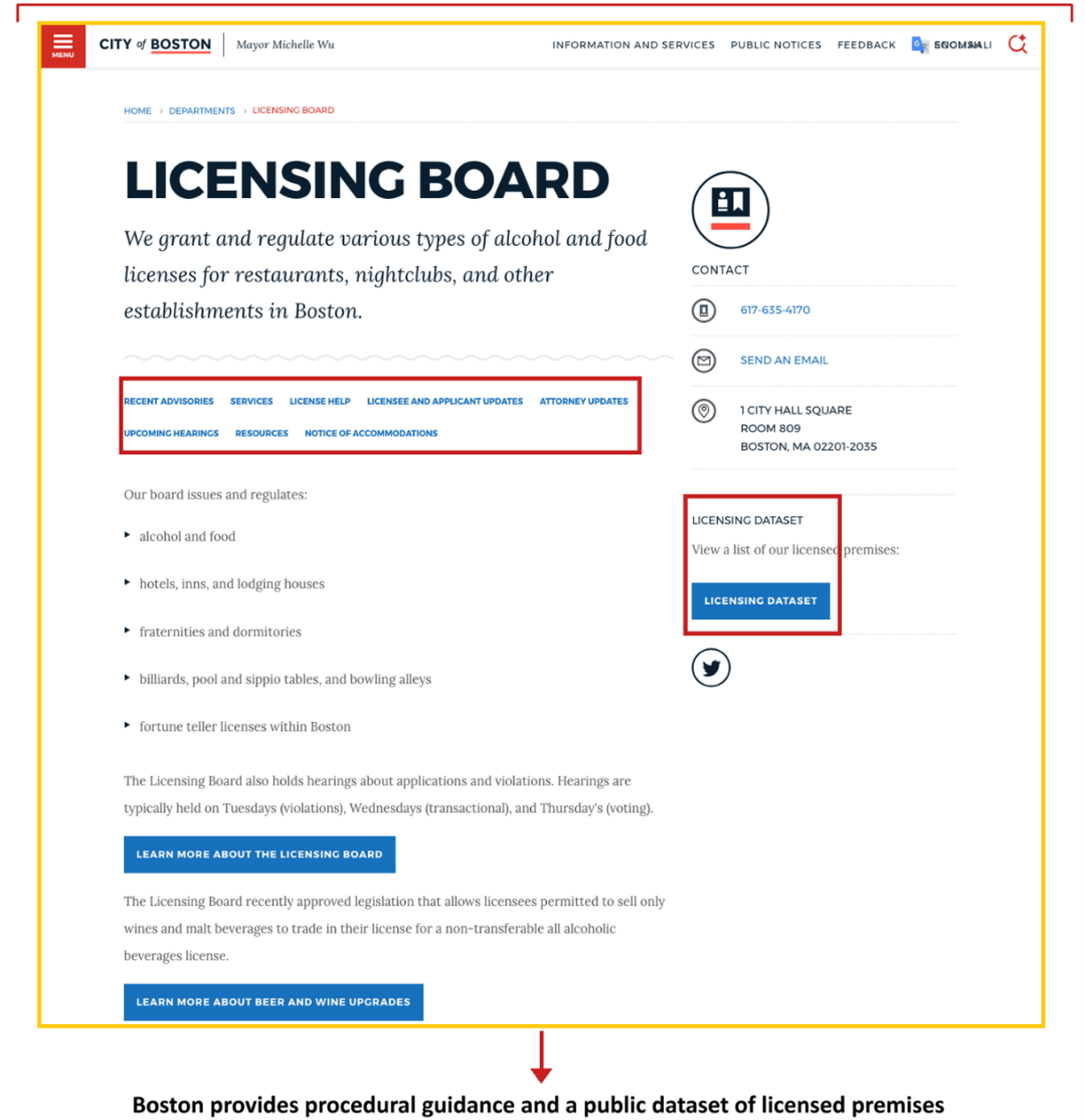
Screenshot of Boston’s Licensing Board webpage showing licensing guidance, hearing information, contact details and a public licensing dataset link. The page provides navigation links for recent advisories, services, license help, licensee and applicant updates, attorney updates, upcoming hearings, resources and accommodations. More information in caption.
Main content body features a formal statement declaring that the board issues and regulates five distinct categories of local business licenses: alcohol and food; hotels, inns and lodging houses; fraternities and dormitories; billiards, pool and bowling; and fortune teller licenses. Hearings are held Tuesdays for violations, Wednesdays for transactional matters and Thursdays for voting. A sidebar provides contact information. A highlighted Licensing Dataset panel links to licensed-premises data, and additional buttons provide licensing guidance, including beer-and-wine upgrades.

Springfield, also a quota municipality, gives applicants a clear starting point with downloadable PDF guides to each license type and its License Commission rules and directs applicants to the state website for additional information.188 See Figure 25 on the next page.

Figure 25. City of Springfield Licensing Board Website189
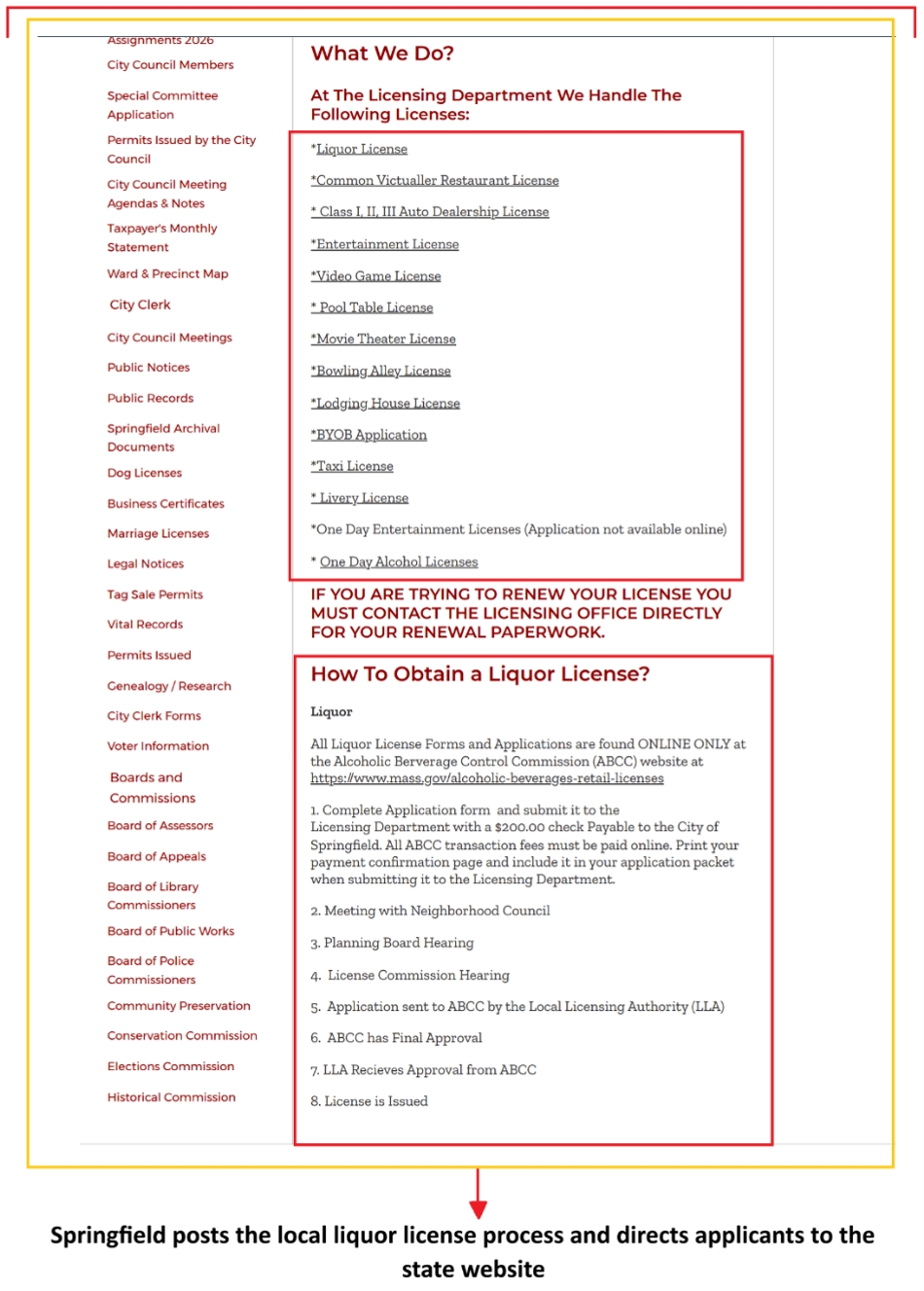
Screenshot of Springfield’s licensing webpage showing license categories and an eight-step liquor license application process. More information in caption.
he digital layout features a long navigation column down the left-hand side. "What We Do" section lists fourteen license types the department handles, each hyperlinked, including liquor, common victualler restaurant, entertainment, lodging house, BYOB and one-day alcohol licenses. A renewal notice written in red capital letters explicitly directs all existing licensees to contact the licensing office directly for renewals. "How To Obtain a Liquor License" section states directly that all required forms are available online only at the state's Alcoholic Beverages Control Commission (ABCC) website. It lists eight numbered operational steps for applicants: 1. Complete the application and submit it locally with a $200 check. 2. Meet with the relevant local Neighborhood Council. 3. Attend a Planning Board public hearing. 4. Attend a Local License Commission hearing. 5. The Local Licensing Authority (LLA) transmits the approved paperwork to the state ABCC. 6. Wait for ABCC final state approval. 7. The LLA receives the final official approval back from the ABCC. 8. The final physical license is formally issued to the business

Worcester’s website provides links to the state website and a permit center that users can contact for assistance.190 It also publishes public notice requirements, rules and regulations, a contact address for reporting concerns, and its most recently updated count of issued licenses (even though, as a local-control municipality, its on-premises licenses are not limited by the state-imposed population-based quota).191 See Figure 26 below and Figure 27 on the next page.

Figure 26. City of Worcester Licensing Board Website192
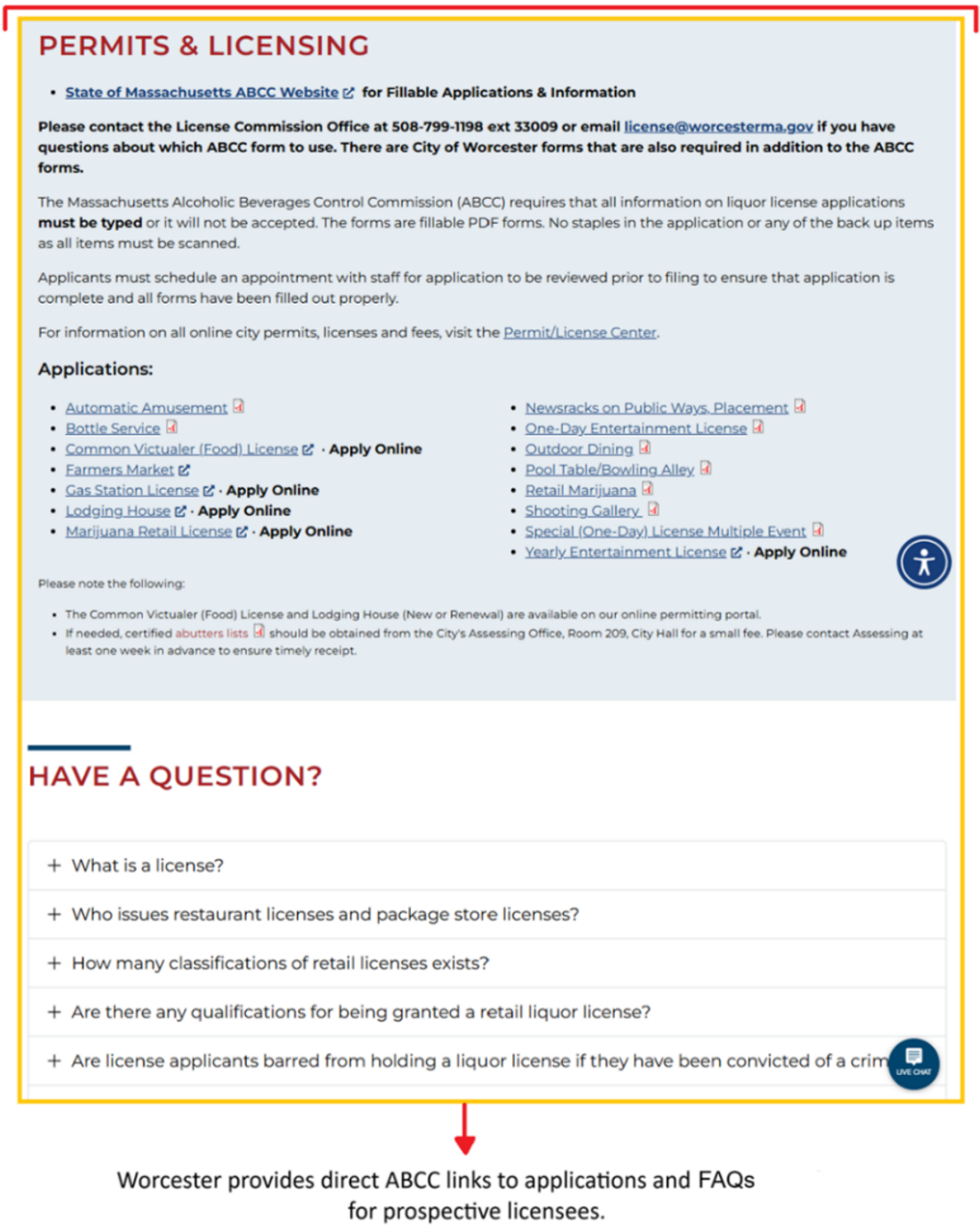
Screenshot of Worcester’s permits and licensing webpage. More information in caption.
A highlighted panel links to the State of Massachusetts ABCC website for fillable applications, gives the license Commission phone extension and email, and sets out requirements: all application information must be typed or it will not be accepted, no staples because all items must be scanned, and applicants must schedule a pre-filing appointment with staff. Sixteen application links run in two columns, several marked "Apply Online," covering automatic amusement, bottle service, common victualler, farmers market, gas station, lodging house, marijuana retail, newsracks, one-day entertainment, outdoor dining, pool table and bowling alley, retail marijuana, shooting gallery, special one-day multiple event, and yearly entertainment. Below, a "Have a Question?" accordion lists five expandable FAQs, beginning with what a license is and who issues restaurant and package store licenses.

Figure 27. City of Worcester Licensing Board Website193
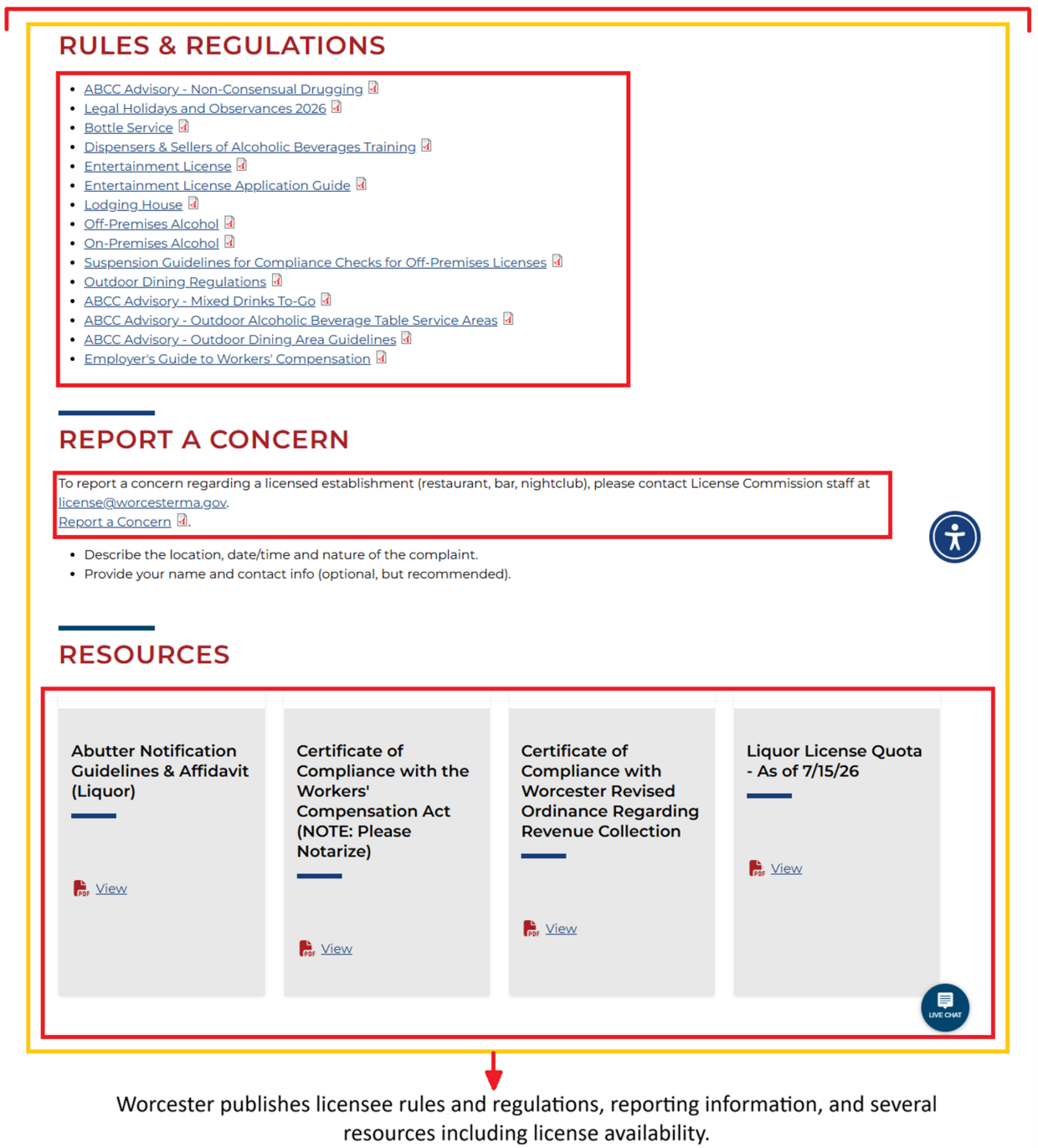
A continuation of City of Worcester Permits and Licensing webpage showing Rules and Regulations, Report a Concern, and Resources sections. More information in caption.
"Rules & Regulations" section lists fifteen linked PDF documents, including ABCC advisories on non-consensual drugging, mixed drinks to-go, outdoor alcoholic beverage table service areas and outdoor dining area guidelines, plus legal holidays and observances 2026, bottle service, dispensers and sellers training, entertainment licensing, lodging house, off-premises and on-premises alcohol, suspension guidelines for compliance checks, outdoor dining regulations and an employer's guide to workers' compensation. "Report a Concern" gives an email address for complaints about a licensed establishment and asks for the location, date and time, nature of the complaint, and optionally the complainant's contact details. "Resources" offers four downloadable cards: abutter notification guidelines and affidavit; certificate of compliance with the Workers' Compensation Act; certificate of compliance regarding revenue collection; and “Liquor Licence Quota - As of 7/15/26" PDF.

Southwick and Palmer, two quota municipalities with fewer than 20,000 residents, which have issued every All-Alcohol license the formula allocates, illustrate the position of smaller municipalities for which the licensing function sits with a general-purpose board rather than a dedicated licensing office. Southwick’s Select Board website provides applications for one-day licenses, and Palmer’s License Commission page provides one-day license guidelines.194 See Figure 28 on the next page.

Figure 28. Licensing websites of Southwick and Palmer195
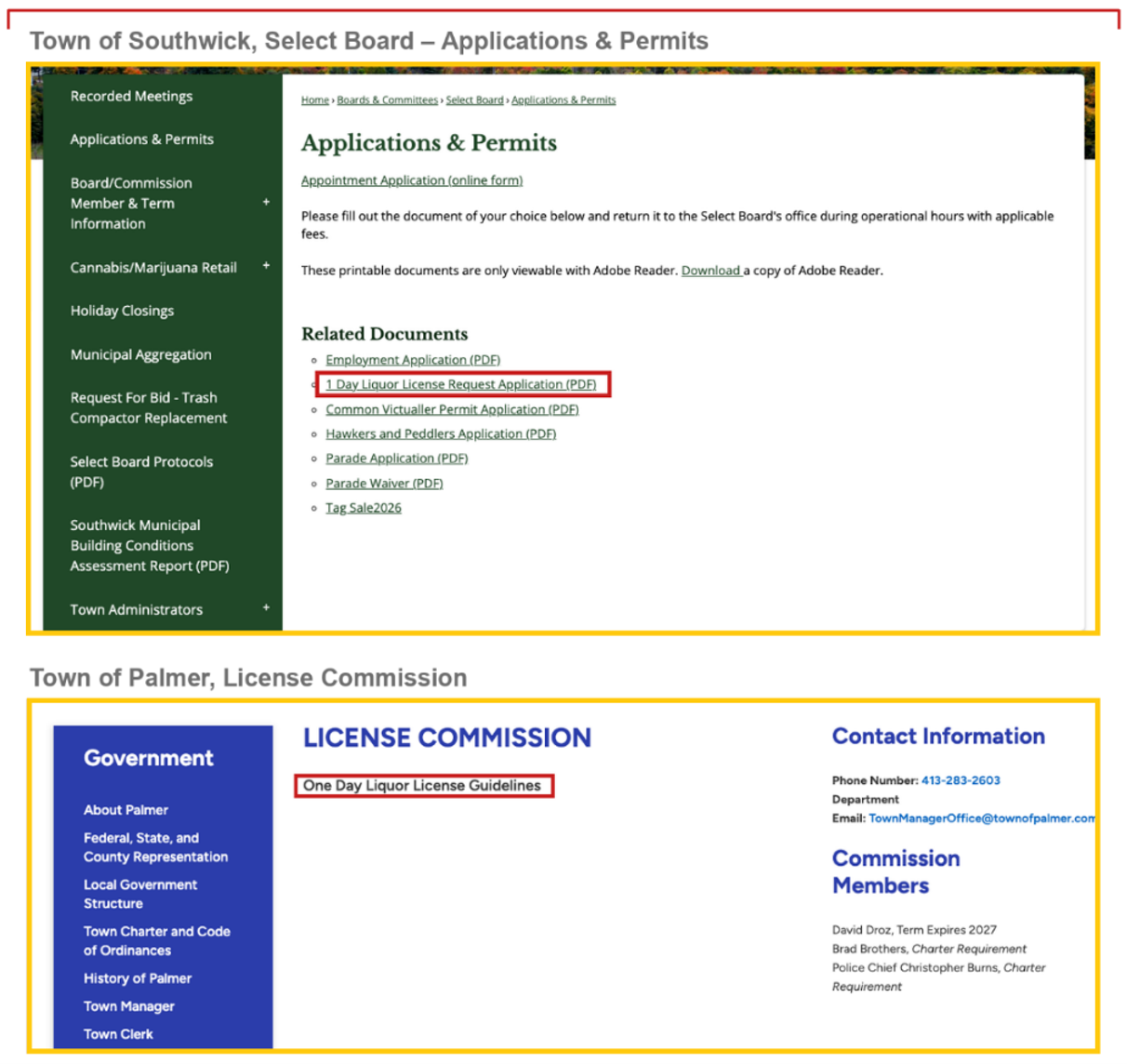
Stacked screenshots of Southwick and Palmers licensing pages. Both municipalities have fewer than 20,000 residents and currently issued every single all alcohol license allocated to them under the state formula, meaning they have no all alcohol licenses left and are quota constrained. More information in caption.
The upper screenshot shows Southwick’s Applications and Permits page with printable documents for employment, one-day liquor licenses, common victualler permits, hawkers and peddlers, parades, parade waivers and tag sales. The lower screenshot shows Palmer’s License Commission page with a One-Day Liquor License Guidelines link, contact information and commission membership.

Municipalities that lack information technology staff members or other resources would benefit from a statewide database that could deliver helpful information to prospective licensees, such as live license data, which is particularly relevant for constrained quota municipalities or municipalities with a high number of special legislation licenses. Respondents to the DLM survey indicate that continuously updated license data should be more readily available.196 Helpful, live license data that could be standardized and centrally collected at the state level includes a map of where issued licenses are located; names of license holders and businesses; types of licenses; classifications of businesses; history and current statuses of licenses; available licenses with information about restrictions, if any; license acquisition costs; and all other information available to ABCC. Moreover, the state does not currently provide website content standards regarding liquor licensing that would benefit potential licensees weighing where to invest, including waiting lists for available licenses, timeline data, municipal contacts, and all other relevant local information.

The website examples show that prospective licensees may encounter very different online informational environments depending on the municipality because there is limited statewide data and no state standardization for website content. Interviews show how these variations in informational environments make the licensing process person-dependent. Complex processes, incomplete written guidance, and a lack of live license data create information asymmetry where some prospective licensees are advantaged by connections with those in the know, such as municipal staff members, ABCC staff members, attorneys, and industry insiders.

When processes are not adequately documented, prospective licensees who lack those connections must rely on whoever will pick up the phone—peers, a helpful clerk, or an industry lawyer. A licensee in Quincy said his most useful guidance came from peers who had been through licensing before and from a city administrative assistant he praised as exactly what a municipal employee should be; he added that ABCC materials exist but remain hard to sort through and would be even harder to sort through for someone navigating the process in a second language.197

Language access compounds these municipal-level barriers. A municipal employee in Lawrence described the need for plain-language guidance and Spanish-language materials, noting that existing materials do not always translate clearly.198 Without plain-language guidance accurately translated, applicants with limited English proficiency may face additional barriers in understanding the sequence of steps, documentation requirements, the hearing process, notice obligations, and available licensing pathways.

Relationship dependence also affects prospective licensees when no license is currently available. Applicants are faced with navigating the difficult pathways of a home rule petition or purchasing a license on the secondary market, as discussed in Finding 4. Without connections to industry insiders, some prospective licensees lack information on how to initiate a home rule petition at the municipal level or how to identify potential licenses for sale, including pocket licenses.199 A Cambridge restaurant owner described the resale market as a small circle of repeat players–“the same lawyers and brokers appear repeatedly”—in which industry insiders are often successful in reacquiring a license when a restaurant fails, while newcomers may have no way to learn when licenses might quietly change hands.200

A lack of clear, consistent, complete, public, and digitized information and live data that can be easily and correctly translated into multiple languages exacerbates the financial barriers identified in Finding 4 and prevents equitable access to the system.

184.      DLM Survey, 2025–2026; DLM Interviews, 2026: needs identified across open-ended survey responses and interviews with applicants and municipal officials.

185.      Views of the municipal websites were captured by dated screenshot. Quota municipalities are subject to the state-imposed population-based quota under MGL c. 138, § 17. Local-control municipalities are authorized to grant on-premises licenses “in addition to, and irrespective of” the state-imposed population-based quota. St. 1978, c. 377, § 2. See Finding 2.

186.      See https://www.boston.gov/departments/licensing-board/apply-alcoholic-beverages-retail-license.

187.      City of Boston Licensing Board, “Apply for an Alcoholic Beverages Retail License,” accessed August 9, 2026, https://www.boston.gov/departments/licensing-board/apply-alcoholic-beverages-retail-license.

188.      City of Springfield, “Process to Obtain Each License Type,” See https://www.springfield-ma.gov/cos/licensing-department.

189.      City of Springfield, Licensing Department, https://www.springfield-ma.gov/cos/‌licensing-department (last accessed September 16, 2026).

190.      City of Worcester License Commission, “License Commission,” accessed August 9, 2026, https://www.worcesterma.gov/‌inspections/license-commission.

191.      Id.

192.      City of Worcester, License Commission, https://www.worcesterma.gov/inspections/license-commission (last accessed July 12, 2026).

193.    City of Worcester, License Commission, https://www.worcesterma.gov/inspections/license-commission (last accessed July 12, 2026).

194.    Analysis of the ABCC fiscal year 2024 annual quota reports and the ABCC fiscal year 2024 active-license extract; utilization excludes special legislation and other exception licenses. Southwick (2023 population 9,195) has issued 14 of 14 allocated All-Alcohol and 5 of 5 Wine-and-Malt licenses (100%); Palmer (2023 population 12,315) has issued 14 of 14 All-Alcohol and 3 of 5 Wine-and-Malt licenses (89.5%) and holds 3 additional All-Alcohol licenses by exception. Both fall in the lowest wealth quartile (Q1) by fiscal year 2026 EQV per capita. Population figures are the 2023 municipal population estimates published by the Department of Revenue, Division of Local Services, Data Analytics and Resources Bureau, “Population By Municipality and Year,” Municipal Databank, accessed September 13, 2026, https://dlsgateway.dor.state.ma.us/reports/rdPage.aspx?rdReport=Socioeconomic.Population.Population. These figures are the US Census Bureau’s annual Population Estimates Program estimates for July 1, 2023—US Census Bureau, Vintage 2023 Population Estimates: City and Town Population Totals, Massachusetts, released May 2024, https://www.census.gov/newsroom/press-kits/2024/subcounty-population-estimates.html

195.    Southwickma.Gov. “Applications & Permits | Southwick, MA.” https://www.southwickma.gov/421/Applications-Permits, (last accessed August 17, 2026). Townofpalmer.Com. “License Commission.” https://www.townofpalmer.com/?SEC=4624F276-58E0-4818-BB6A-FD51DE6B763E, (last accessed August 17, 2026).

196.    DLM Interviews, 2026.

197.    DLM Interviews, 2026.

198.    DLM Interviews, 2026.

199.    DLM Interviews, 2026.

200.    DLM Interviews, 2026.

Date published: October 13, 2026

Help Us Improve Mass.gov  with your feedback

Please do not include personal or contact information.
Feedback