
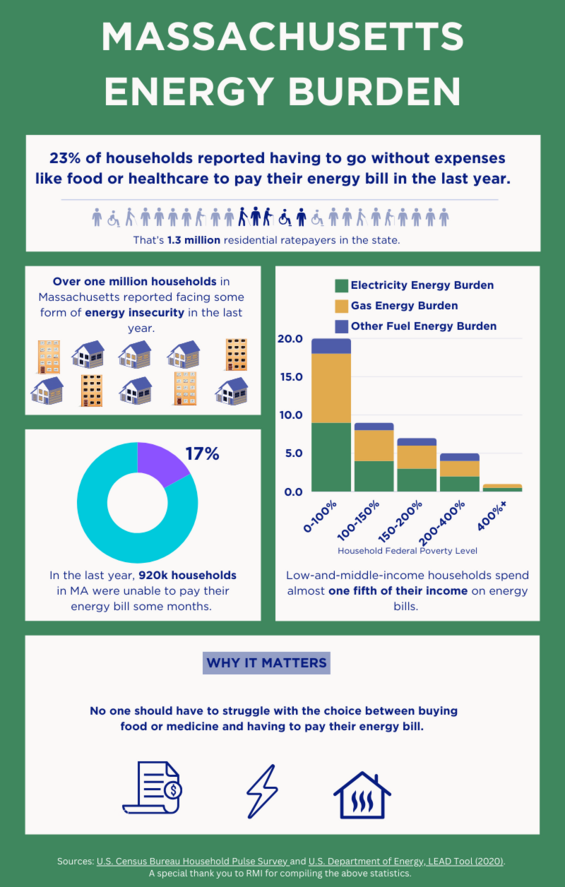
The Energy Burden in Massachusetts
Update: Phase I Order
On February 17, 2026, the DPU issued an order on Phase I of the proceeding, issuing specific directives for both the electric and gas utility companies. The order directs these companies to implement six tiered discount rates for low-income customers. Each tier is designed to reach a target energy burden (percentage of household income spent on energy) for qualifying customers.
These six tiered discount rates will be uniform across all electric and gas utility companies and will be no less than 15 percent for qualifying gas utility customers and 25 percent for qualifying electric utility customers.
The six tiers will match the definitions under the federal Home Energy Assistance Program (HEAP) for households earning a certain percentage of the federal poverty limit (FPL).
- Households earning less than or equal to 100 percent of FPL (The 2025 Federal Poverty Level (FPL) for a single individual is $15,650 annually ($1,304/month), increasing to $32,150 for a family of four.) ;
- Households earning greater than 100 percent and less than or equal to 125 percent of FPL (125% of the FPL in Massachusetts for a single person is approximately $18,825–$19,950 annually ($1,569–$1,662 monthly). For a family of four, the threshold is approximately $37,500–$41,250 annually.);
- Households earning greater than 125 percent and less than or equal to 150 percent of FPL (150% of the FPL in Massachusetts for a single person is approximately $1,957–$1,995 monthly ($23,500–$23,940 annually) and for a family of four is approximately $4,020 – $4,125 per month ($48,200–$49,500 annually);
- Households earning greater than 150 percent and less than or equal to 175 percent of FPL (175 percent FPL is approximately $27,387.50 annually ($2,282 monthly);
- Households earning greater than 175 percent and less than or equal to 200 percent of FPL (200% of the FPL in Massachusetts for a single person is approximately $31,920 annually ($2,660 monthly), and $66,000 annually ($5,500 monthly) for a family of four.; and
- Households earning greater than 200 percent of FPL and less than or equal to 60 percent of SMI (60% of the Estimated State Median Income (SMI) for a 1-person household is $51,777 and for 4-person household is approximately $99,573.
The lowest tier of the discount rates will apply to households earning less than or equal to 100 percent of the FPL. The discount rate applied for these qualifying customers will achieve a total energy burden of four percent: a two percent energy burden for electric customers and a two percent burden for gas heating bills. Eligible non-heating gas customers will have 0.5 percent energy burden.
For the other five tiers, discount rates will achieve a total energy burden of six percent: a three percent target energy burden each for electric customers and gas heating customers and a 0.75 percent target energy burden for gas non-heating customers
The companies must submit compliance filings to the DPU within 60 days of the order. The utility companies must then implement the new tiered discount rates by November 1, 2026.
In addition to instructing the utilities to implement tiered discounts, the DPU directed all utility companies to cease charging low-income discount customers for the Residential Assistance Adjustment Factor (RAAF).
Please click on the link below to read the full order.
Summary
On January 4, 2024, the Department of Public Utilities (DPU) voted to open an inquiry to examine energy burden with a focus on energy affordability for residential ratepayers. Please see the Notice of Inquiry by the Department of Public Utilities on its own Motion into Energy Burden with a Focus on Energy Affordability for Residential Ratepayers, D.P.U. 24‑15, Vote and Order Opening Inquiry (January 4, 2024) (“Opening Order”).
In the Opening Order, the DPU provided background on these issues, an overview of the current methods that the DPU uses to address energy affordability, and a variety of questions seeking input on how the DPU can reduce the energy burden and address affordability issues. The DPU encouraged all interested persons to participate in this proceeding by supplying written comments on this topic by March 1, 2024. Links to Opening Order, the Notice, and other documents related to this inquiry are available below. Please also see the press release issued by the DPU, available in 简体中文 | Kreòyl ayisyen | Português, Brasil | Español.
After receiving over 100 comments from various stakeholders and following the virtual workshop held on June 24, 2024, the DPU issued an interlocutory order with focused questions on areas of consensus to seek input on these issues. The DPU solicited written comments on any or all of the above-noted issues by Friday, November 1, 2024. The DPU also held a technical session on January 28, 2025.
The DPU held a virtual technical session on June 10, 2025, to gather feedback on the model developed to calculate discount rates for its Energy Burden docket. The DPU held a meeting of the Phase II Working Group on August 20, 2025. Phase II of the proceeding is still underway.
Additional Resources
-
24-15 Notice Memo TDR & Tech Conference, Open PDF file, 170.48 KB (English, PDF 170.48 KB)
-
24-15 TDR Model, Open XLSX file, 113.1 KB (English, XLSX 113.1 KB)
-
24-15 Checklist for TDR Model, Open XLSX file, 11.38 KB (English, XLSX 11.38 KB)
Additional Resources
-
National Consumer Law Center Presentation on PIPPs TPD, Open PPTX file, 222.72 KB (English, PPTX 222.72 KB)
-
Conservation Law Foundation & Environmental Defense Fund Presentation, Open PDF file, 486.13 KB (English, PDF 486.13 KB)
-
Low Income Energy Affordability Network (LEAN) Presentation TPD, Open PPTX file, 6.38 MB (English, PPTX 6.38 MB)
-
RMI Presentation TPD, Open PPTX file, 3.76 MB (English, PPTX 3.76 MB)
-
Attorney General's Office Presentation II, Open PDF file, 1.74 MB (English, PDF 1.74 MB)
-
Attorney General's Office Presentation I, Open PDF file, 9.53 MB (English, PDF 9.53 MB)
-
Joint Presentation by the Gas and Electric Distribution Companies TPD, Open PDF file, 213.54 KB (English, PDF 213.54 KB)
-
Greater Lawrence Community Action Council, Inc. Presentation TPD, Open PPTX file, 418.83 KB (English, PPTX 418.83 KB)